
Table of Contents
- Why Core Peptides Alternatives Matter for Purity Verification
- How to Read a Peptide Certificate of Analysis
- Third-Party Peptide Testing Labs and Methods
- Where to Buy Research Grade Peptides Online
Last Updated: August 17, 2026
Why Core Peptides Alternatives Matter for Purity Verification
When sourcing research-grade peptides, purity verification isn’t optional, it’s foundational. A peptide‘s analytical purity directly determines whether your research results are reliable or compromised. Not all suppliers provide equivalent verification methods, and understanding which core peptides alternative for purity verification actually delivers matters more than price alone.
RRK Labs addresses this by prioritizing independent third-party testing via HPLC and mass spectrometry for every batch, with certificates of analysis provided upfront. Understanding the technical differences between HPLC, mass spectrometry, capillary electrophoresis, and NMR spectroscopy helps you evaluate whether a supplier’s claims align with your research requirements.
Purity verification is your first line of defense against compromised research. The method matters as much as the reported percentage, a 99% HPLC result means nothing if the analytical method wasn’t sensitive enough to detect the impurities present.
How to Read a Peptide Certificate of Analysis
A certificate of analysis (COA) is your primary document for verifying what you’ve received matches what you ordered. Most researchers scan the purity percentage and move on. That’s a mistake.
A properly structured COA identifies the peptide by sequence or catalog number, lists the batch number, and states the testing date. The molecular weight confirmation verifies the peptide’s identity at the mass level. The HPLC purity percentage typically appears as a single value (e.g., 97.3%), but the real story is in the chromatographic profile. A legitimate COA references the wavelength used for detection (usually 214 nm or 280 nm), the column type, and the solvent system.
The third-party lab name should be clearly stated with contact information, allowing you to verify the lab’s credentials directly. Acceptance criteria matter enormously, a supplier claiming 99% purity is only meaningful if you know their threshold. Some labs report "area under curve" purity (all detectable peaks), while others report "peak purity" (main compound only). The difference can be several percentage points for the same sample.

Common red flags include missing batch numbers, undated results, vague lab identification, and purity percentages without accompanying analytical method details. Reputable suppliers like RRK Labs provide full analytical documentation, not just a summary purity number.
A COA without a specific third-party lab name or testing methodology is essentially worthless. You cannot verify it, and you have no recourse if results are disputed. Always request the full analytical report, not just a summary sheet.
Third-Party Peptide Testing Labs and Methods
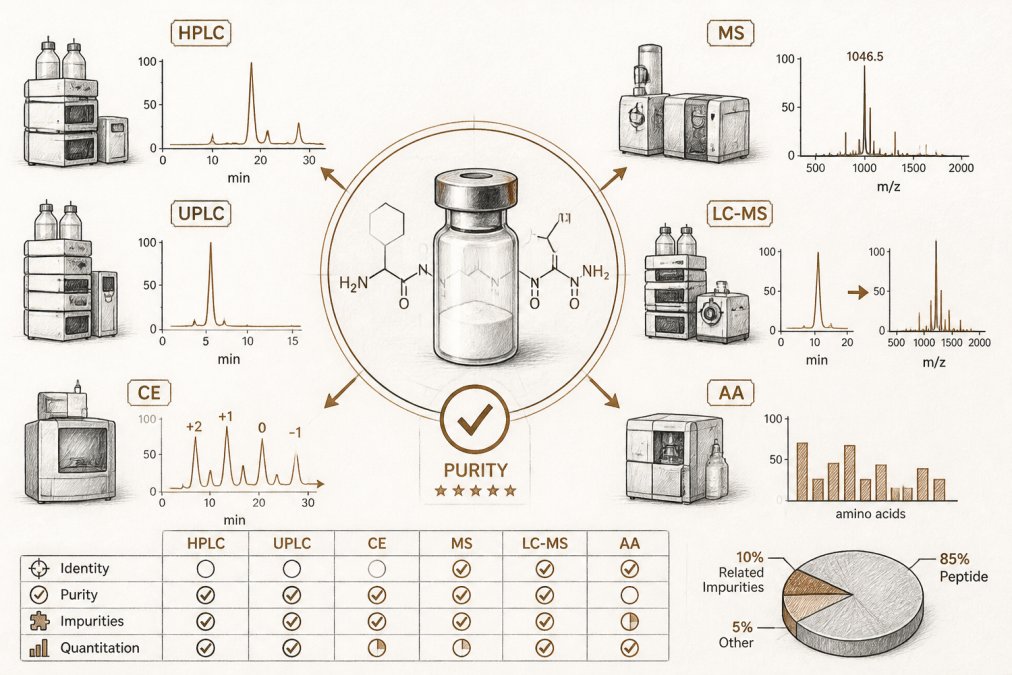
Understanding the analytical methods behind purity verification transforms how you evaluate suppliers. Each method has distinct strengths, and the best core peptides alternative for purity verification combines multiple techniques rather than relying on a single approach.
High-performance liquid chromatography (HPLC) remains the industry standard for peptide purity analysis. It separates compounds based on their interaction with a stationary phase, allowing quantification of the main peptide and impurities. HPLC is fast, cost-effective, and widely standardized, though it cannot distinguish between structural isomers or confirm molecular identity.
Mass spectrometry (MS) addresses this by measuring the exact mass-to-charge ratio of the peptide and contaminants. The Thermo Scientific Q Exactive Hybrid Quadrupole-Orbitrap Mass Spectrometer offers resolving power up to 240,000 at m/z 200, enabling detection of impurities differing by less than 5 parts per million. MS confirms molecular identity with certainty and identifies unexpected contaminants, though at higher cost and complexity.
Capillary electrophoresis (CE) separates peptides based on size, charge, and hydrophobicity under high voltage, excelling at detecting aggregates and degradation products that HPLC might miss. Nuclear magnetic resonance (NMR) spectroscopy analyzes atomic nuclei to verify molecular structure and identity. Quantitative NMR (qNMR) provides absolute purity values without requiring a reference standard, though it cannot detect impurities below roughly 1-2% of the total sample.
| Method | Detection Sensitivity | Cost per Sample | Time to Result | Structural Detail | Best For |
|---|---|---|---|---|---|
| HPLC | High | Low | 30 min | Limited | Routine purity screening |
| Mass Spectrometry | Very High | High | 1-2 hours | Excellent | Identity confirmation, trace impurities |
| Capillary Electrophoresis | High | Medium | 1 hour | Good | Aggregates, degradation products |
| NMR Spectroscopy | Medium | Medium | 2-4 hours | Excellent | Structural verification, absolute purity |

The best suppliers combine methods. HPLC provides fast screening and quantification, while MS confirms identity and detects trace impurities. RRK Labs uses both HPLC and mass spectrometry for every batch, combining the speed of HPLC with the precision of MS to ensure both purity and identity are verified.
Request samples tested by both HPLC and mass spectrometry if your research requires absolute confidence in peptide identity. The cost difference is minimal compared to the risk of compromised results from a single-method analysis.
Where to Buy Research Grade Peptides Online
Finding a reliable supplier for research-grade peptides means evaluating not just price but the depth of verification they provide. The market has fragmented into suppliers offering different levels of analytical rigor, and your choice directly impacts research reproducibility.
RRK Labs stands out by offering 99%+ HPLC-verified purity with independent testing via both HPLC and mass spectrometry. Every batch includes a certificate of analysis, with next business day dispatch and discreet, unbranded packaging.
When evaluating purity verification alternatives online, look for suppliers that clearly document their testing methodology, provide batch-specific COAs (not generic summaries), and allow you to contact their testing laboratory directly if needed. Price variation between suppliers claiming similar purity levels reflects testing depth. A supplier offering low prices may be using HPLC alone without MS confirmation or older analytical equipment with lower sensitivity.
Match the verification method to the stakes of your research. For preliminary in-vitro studies, HPLC purity verification from a reputable supplier is typically sufficient. For published results or research where peptide identity is critical, demand MS confirmation.
RRK Labs is best for researchers who need verified purity with minimal procurement friction, independent testing, documented quality control, and fast delivery without the complexity of coordinating with multiple testing services.
Frequently Asked Questions
What should I look for in a Certificate of Analysis for purity verification?
A valid COA must include the peptide sequence or identity, purity percentage measured by HPLC (typically ≥95% for research-grade), molecular weight confirmation, batch number, testing date, and the name of the independent third-party laboratory. Verify that the purity threshold matches your research requirements and that the lab is accredited. Red flags include missing lab credentials, vague purity descriptions, or undated results.
Why is third-party peptide testing labs essential instead of supplier in-house testing?
Third-party labs provide independent verification that removes conflicts of interest. In-house testing by suppliers lacks external oversight and cannot guarantee impartiality. Independent labs follow standardized protocols, maintain accreditation, and provide defensible documentation for peer-reviewed research. This independence is critical for academic institutions and regulatory compliance in pharmaceutical development.
How do HPLC and mass spectrometry differ for peptide purity verification?
HPLC separates peptides by physical properties and measures purity as a percentage by peak area, showing what fraction is your target compound. Mass spectrometry confirms molecular weight and identifies impurities by their mass signatures, providing structural insight. HPLC is faster and less expensive; MS offers greater specificity. Many labs use both together for comprehensive purity verification.
Where can I buy research grade peptides online with verified purity documentation?
Reputable suppliers provide batch-specific Certificates of Analysis from independent labs with every order. When evaluating online vendors, confirm they offer HPLC-verified purity ≥95%, independent third-party testing, next-business-day dispatch, and discreet packaging. Request references from academic institutions or verify accreditation through industry standards. Avoid suppliers who cannot provide detailed COA documentation or who only offer in-house testing.
What are common impurities I should expect to see listed on a peptide COA?
Common impurities in synthetic peptides include incomplete sequences, deletion sequences, acetate or trifluoroacetic acid residues from synthesis, water content in lyophilized powder, and aggregated peptide chains. A detailed COA identifies these by name and percentage. Understanding these impurities helps you assess whether the batch meets your research specifications and whether any may interfere with your experiments.
When evaluating where to source research-grade peptides, the real differentiator is transparency in testing. RRK Labs delivers this through independent HPLC and mass spectrometry verification for every batch, paired with accessible documentation and reliable dispatch. Shop the catalogue to see current offerings and request batch-specific certificates of analysis for any peptide before ordering. Your research deserves inputs you can trust.
This article was written using GrandRanker